SUBJECT: Negative Effects of Digitalization Without a Strategy
Negative Consequences of Digitalization Without a Strategy and Action Plan
> Key findings from digital risk analysis
Ill-conceived digitalization carries operational risks that often outweigh the initial benefits of implementing new technology. The main conclusion from risk analysis is that automating flawed processes without a prior audit only leads to automated chaos, which generates errors faster and on a larger scale than analog systems. It is crucial to understand that technology should stem from a solid business strategy rather than being an end in itself, which helps avoid wasting capital on solutions that do not solve real problems.
- Automated chaos - implementing systems without a prior audit means process errors are replicated instantly. A proper proces digitalizacji danych krok po kroku requires organizing information flow first to avoid digitalizing inefficiency, which eventually becomes a barrier to growth.
- Human middleware cost - the biggest financial burden is not software licensing fees, but the need to involve employees in manually retyping data between incompatible systems. To eliminate this bottleneck, companies implement automatyzacje procesow that merge the tool ecosystem and free up resources for more profitable tasks.
- Vendor lock-in trap - lack of source code ownership makes the enterprise dependent on a single provider, drastically limiting flexibility and scalability. This is why a strategia finansowania cyfryzacji - jak inwestowac w technologie na wlasnosc becomes a key element in building a lasting market advantage over competitors using only SaaS models.
- Lack of scalability and tech ceiling - off-the-shelf solutions often block the development of specific business processes in SMEs. In such cases, aplikacje dedykowane work best because they have no technological ceiling and grow with the company's needs.
- Misunderstanding real ROI - many organizations focus on purchase costs instead of analyzing the long-term rate of return. Meanwhile, the real korzysci z cyfryzacji procesow biznesowych are measurable through reduced customer service time and error elimination, directly impacting the financial result.
Proper risk analysis shows that the foundation of success is maintaining full control over the company's technological DNA. When choosing tailor-made solutions, it is also worth considering szkolenia AI dla biznesu, so the team can use modern tools consciously rather than becoming their slave.
> What are the most serious consequences of unplanned digitalization
The most serious consequence of unplanned digitalization is the creation of operational chaos, which generates hidden costs far exceeding the purchase price of the licenses themselves. The lack of a coherent vision means that instead of supporting growth, new technology becomes an anchor blocking the team's daily activities. As a result, the company loses information fluidity, and employees return to old habits, leading to decision-making paralysis and a rapid loss of market advantage over more organized competitors.
From a practical technology management perspective, the biggest burden on the budget is not the invoice amount for new software, but a drastic drop in morale. When an organization implements systems conceived in boardrooms while ignoring how processes actually look on the ground, these tools become an obstacle for people rather than an aid. A properly developed strategia finansowania cyfryzacji helps avoid the trap where you pay thousands per month for an empty system while your team quietly keeps their own parallel records in spreadsheets.
The lack of an IT plan carries specific risks:
- Team work paralysis - if a tool is too complex or mismatched with work realities, employees start bypassing it, which destroys data consistency across the company.
- Loss of competitive advantage - chaotic technological moves mean the company cannot react quickly to market changes because its systems are not integrated. In such situations, often only aplikacje dedykowane designed for specific bottlenecks allow regaining control over processes.
- Lack of measurable effects - without clearly defined goals, it is impossible to achieve real korzysci z cyfryzacji, which usually discourages owners from further investment in development.
- Growing technical debt - patching process holes with random, incompatible plugins makes later, more advanced automatyzacje procesow extremely difficult and expensive to implement.
If you implement a system without asking people how they actually work, you are building a digital wall between management and operations. Employees, feeling resistance to imposed solutions, return to proven methods like Excel on the side, making your technology investment completely useless.
> Technological silos as a result of buying tools without an audit
Buying software as a shortcut, without a prior audit of real needs, is the fastest way to create technological chaos. We often meet clients who, in a burst of enthusiasm for digitalization, purchased five different SaaS systems - separately for email, invoices, warehouse, or logistics. The problem arises when these tools become isolated islands that do not exchange information. The business owner then loses insight into the real state of finances because data is scattered and inconsistent. To avoid these traps, a well-thought-out strategia cyfryzacji is key, treating technology as a coherent ecosystem rather than a collection of random subscriptions.
Lack of information flow between departments
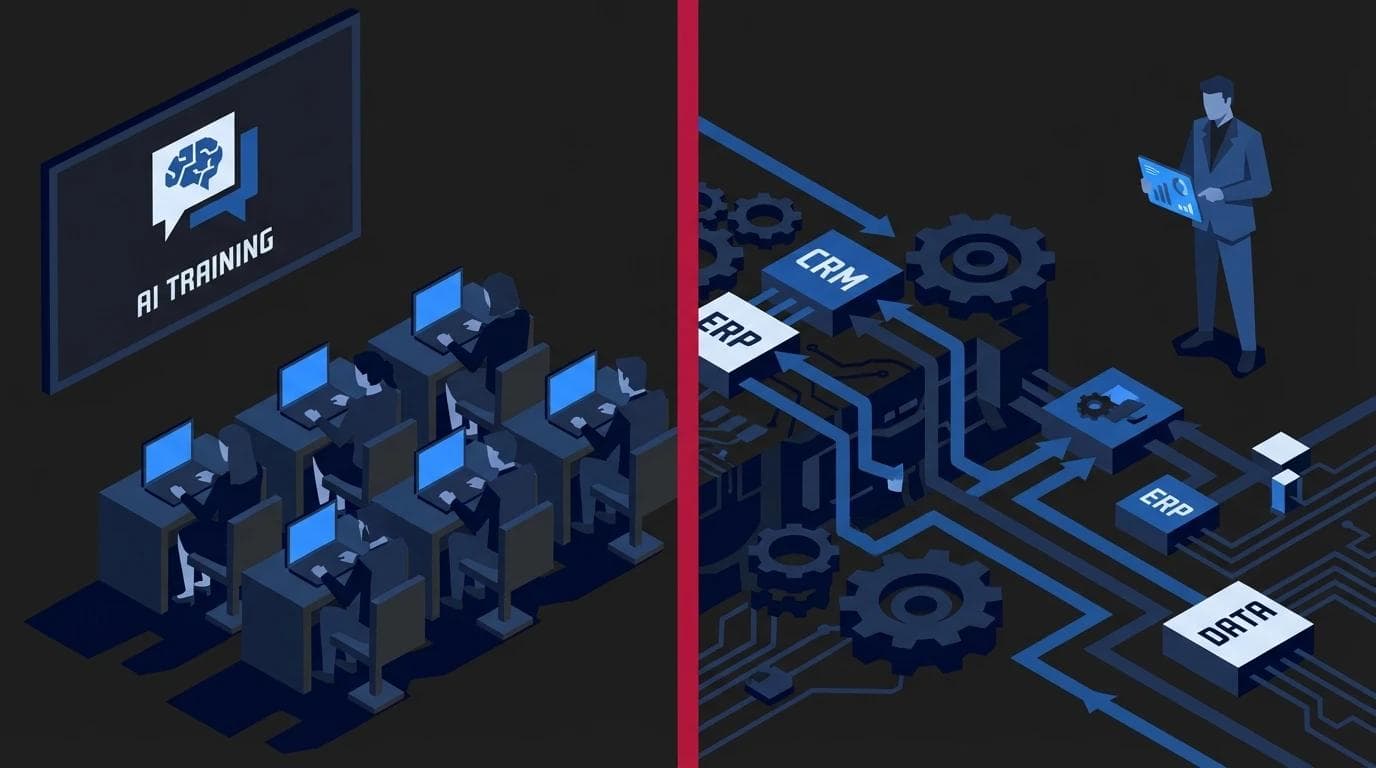
When systems do not talk to each other, the burden of communication falls on the employees. We see this in companies where an accountant must manually retype statuses from a warehouse sheet into the financial system every day. This situation not only generates errors but completely nullifies the theoretical korzysci z cyfryzacji, turning modern tools into a digital prison. Even a correctly performed proces digitalizacji danych krok po kroku loses meaning if data gets stuck in silos without the possibility of automatic transfer. The solution often turns out to be tailor-made automatyzacje procesow that build bridges between existing software.
Duplicated functions and redundant license costs
Lack of central planning leads to budget waste on functions the company already possesses in other tools. It happens that three different departments pay subscriptions for task management systems because no one conducted a resource audit. Companies without an audit often unknowingly duplicate spending on:
- CRM systems - when sales and marketing departments use two different customer databases without synchronization.
- Communication tools - paying for several platforms with the same chat and video functions simultaneously.
- Cloud resources - unnecessary subscriptions for scattered disk space across multiple services.
In such cases, it is worth considering aplikacje dedykowane that integrate all necessary modules in one place. Understanding how to optimally select technology is facilitated by professional szkolenia AI dla biznesu, which teach management to look at IT through the lens of operational efficiency. Without this, the company risks losing control over its own tech stack, which prevents consistent cyfryzacja dokumentow and hampers the entire enterprise's growth.
> Why IT implementation without process optimization generates losses
Implementing IT systems without prior process optimization generates losses because digitalizing chaos only results in its acceleration and increased operational costs. Instead of eliminating inefficiency, technology freezes flawed operational patterns, making them harder to change in the future. Without a pre-implementation audit, the company invests in tools that do not solve problems at the source but merely create an expensive digital overlay on dysfunctional procedures.
At 01tech, we have an ironclad rule: technology must support a logical business process. We often encounter situations where companies want to automate a complex document workflow without simplifying the decision path itself. If in your enterprise, the approval of minor costs is full of bureaucratic absurdity - for example, three managers must sign off on buying pencils - then implementing expensive software will simply move this absurdity online. You will pay for a complex program that maintains old bottlenecks, and employees will still waste time on unnecessary clicks instead of real work.
An improper approach to transformation carries specific financial risks:
- Perpetuating inefficiency - an IT system forces users to follow a rigid logic which, in the absence of optimization, replicates old errors.
- Costs of additional modifications - when it later turns out that the system does not bring expected profits, expensive code fixes are necessary, which could have been avoided with a proper strategia cyfryzacji developed at the start.
- Drop in team morale - employees see that the new tool does not make their lives easier, which builds resistance to further technological changes.
Properly designed aplikacje dedykowane should be a cure for bureaucracy, not its carrier. Before a software purchase decision is made, a reliable proces digitalizacji is essential, starting with the analysis and simplification of information flow. Only after eliminating unnecessary steps can you think about how automatyzacje procesow will speed up the company's operations.
A common mistake is the belief that cyfryzacja dokumentow in itself will increase efficiency. Meanwhile, without changing the logic of information flow, the only effect will be filling servers with digital versions of unnecessary forms. Real korzysci z cyfryzacji appear only when technology goes hand in hand with optimization. If you feel your current processes require simplification before IT implementation, it is worth making kontakt with experts who will help separate technology from bureaucratic noise.
> The SaaS trap and loss of control over technological ownership
The SaaS (Software as a Service) model is becoming a financial trap for many small and medium-sized enterprises, where initially low costs grow exponentially with the scale of operations. Lack of source code ownership and full control over data creates a barrier we at 01tech call the growth tax, preventing flexible responses to market changes without incurring huge subscription fees. Buying software out of the box is often a perceived saving that generates technical debt in the long run.
Choosing a ready-made system seems tempting due to the low barrier to entry - you buy access for 500 PLN per month and can start working immediately. However, a subscription mechanism based on the number of seats means that when you hire 50 people next year, you already pay 10,000 PLN per month for the exact same tool that offers no additional value beyond access itself. In such a scenario, a strategia finansowania cyfryzacji should involve building your own assets rather than just renting someone else's infrastructure.
Another threat is so-called vendor lock-in, or total dependence on the provider. You are trapped - if the provider suddenly raises prices by 30% or changes key functionalities, your room for maneuver is close to zero. Migrating critical operational data would often involve blocking company processes for weeks, which is why a proper proces digitalizacji danych must include full sovereignty over information. By investing in aplikacje dedykowane, you build the company's equity, which increases its market valuation.
Risks associated with chaotic subscription selection include:
- Scaling costs without value growth - subscription fees grow with your company's success and the number of employees, becoming a burden that hampers further expansion.
- Lack of operational flexibility - ready-made systems rarely allow for deep automatyzacje procesow tailored to your unique specifics, forcing the team to manually compensate for software shortcomings.
- Loss of control over the product roadmap - the SaaS provider decides which features are added and which are removed, which can destroy your existing korzysci z cyfryzacji achieved in other areas.
- Difficulties in data integration - scattered subscriptions make effective cyfryzacja dokumentow and maintaining a coherent information flow within the organization difficult.
Regaining control over technology avoids situations where your operational data is a hostage of an external corporation. Code ownership is the freedom to modify the system exactly when the market requires it, without waiting for global software provider decisions.
> How to move from chaos to a profitable digital strategy
Effective digital transformation does not start with buying an expensive license, but with a piece of paper and a pen. To move from technological chaos to profitability, you must first understand the real workflow in your company before investing in any software. At 01tech, we believe that every line of code must earn its keep, which is why before any aplikacja dedykowana is created, we go to the employees and meticulously map their daily tasks. Only such an approach allows capturing korzysci z cyfryzacji that translate into a measurable return on investment.
The process of building a lasting technological advantage can be summarized in three key steps:
- Inventory and process mapping - before implementing new solutions, check where your people waste time duplicating the same activities. Cutting unnecessary, double steps is the cheapest and most effective optimization method, making subsequent automatyzacja procesow logical and profitable.
- Data and documentation management - an organized proces digitalizacji avoids situations where information is scattered across dozens of spreadsheets. Properly implemented cyfryzacja dokumentow ensures information consistency and facilitates decision-making based on facts, not hunches.
- Choice of ownership model - a well-thought-out strategia finansowania cyfryzacji should involve building your own technological assets instead of perpetual tool rental. By taking control of the code, you eliminate the technological ceiling and gain flexibility that standard SaaS systems do not offer.
Only then do we select or write our own tool for such a cleared process, which drastically shortens software production time and guarantees that the investment earns money from day one. If you feel that technology in your company is becoming a burden instead of helping, we invite you for a consultation and contact to jointly plan a profitable growth path for your business.
> Frequently asked questions about risks and consequences of digitalization
Entrepreneurs often fear that technical transformation will introduce even more disorder into the company instead of helping. Understanding potential threats is key to designing a solution that brings a real return on investment.
Does every digitalization involve the risk of creating silos?
The risk of information silos always exists when implementation is fragmented, without a broader vision of data architecture. If each department chooses its own tools in isolation from the rest of the organization, the flow of information is blocked. A properly planned proces digitalizacji danych avoids this problem by designing systems with mutual communication in mind. Integrating systems from the start guarantees that data from production, sales, and logistics will be consistent and available in one place.
How to recognize that my company suffers from IT chaos?
Technological chaos is not always visible at first glance, but its symptoms quickly translate into financial results. It is worth paying attention to the following signals:
- Low efficiency with high costs - when you pay for many SaaS licenses, and employees still perform most tasks manually in spreadsheets.
- Employee resistance to new tools - the team is reluctant to use systems that are unintuitive or duplicate their work.
- Lack of trust in data - when different reports show conflicting numbers regarding the same process.
In such cases, professional automatyzacje procesow become essential, relieving the team of repetitive tasks and organizing information flow. Often the first step is also cyfryzacja dokumentow, which eliminates bottlenecks in paper communication.
How much does it cost to fix a flawed digitalization strategy?
The costs of fixing errors are significantly higher than investing in well-thought-out solutions at the start. In the SME sector, skilled employees lose 20% to 30% of their time looking for lost data in disconnected databases. This translates into tens of thousands of PLN burned in man-hours every month. Additionally, there are expenses for data migration and architecture rebuilding.
Can a failed IT system be saved? From our experience, yes. Instead of completely turning off existing software, we often write invisible integration scripts via API that automatically transfer data between systems and save process fluidity. However, if systems are too outdated, it is better to opt for aplikacje dedykowane, which provide full code ownership and no technological ceiling. A solid strategia cyfryzacji is the foundation that allows obtaining measurable korzysci z cyfryzacji without the risk of throwing money away. If you feel your technology is limiting you, it is worth making kontakt with experts to audit current solutions.