SUBJECT: Document Digitalization for Small Business - How to Start
Document Digitalization in Small Business and Effective Methods for Process Change
> Key Takeaways Regarding Document Process Digitalization
Document digitalization is a process that involves transforming traditional paper-based information flow into an integrated digital system, aimed at shortening operation times and reducing costs. True transformation goes beyond simple file scanning - it requires remodeling business logic so that data works to the company's advantage. A key element here is an appropriate digitalization financing strategy that allows avoiding dependence on external vendors and building real company value.
Digitalized mess is not digitalization - at 01tech, we often encounter the belief that scanning documents and storing them on Google Drive solves the problem. This is a mistake because, without proper structure and metadata, we only create digital chaos where finding information takes as much time as in a paper archive. Real technology implementation must give data context and facilitate its processing.
Optimization before implementation - before new tools appear in the company, current procedures should be critically assessed. It often turns out that many approval steps or signatures are completely redundant, and moving them thoughtlessly to the digital world will only perpetuate inefficiency. Effective process automations always start by throwing outdated bureaucratic habits into the trash and simplifying the information flow path.
The SaaS model trap - ready-made cloud systems tempt with a low entry threshold, but in the long run, they penalize the company for its success and growth. Fees for every uploaded PDF or every new employee cause operational costs to grow exponentially with the scale of the business. For this reason, for many SMEs, custom applications are much more profitable, representing a one-time investment cost and ensuring full code ownership and technological independence.
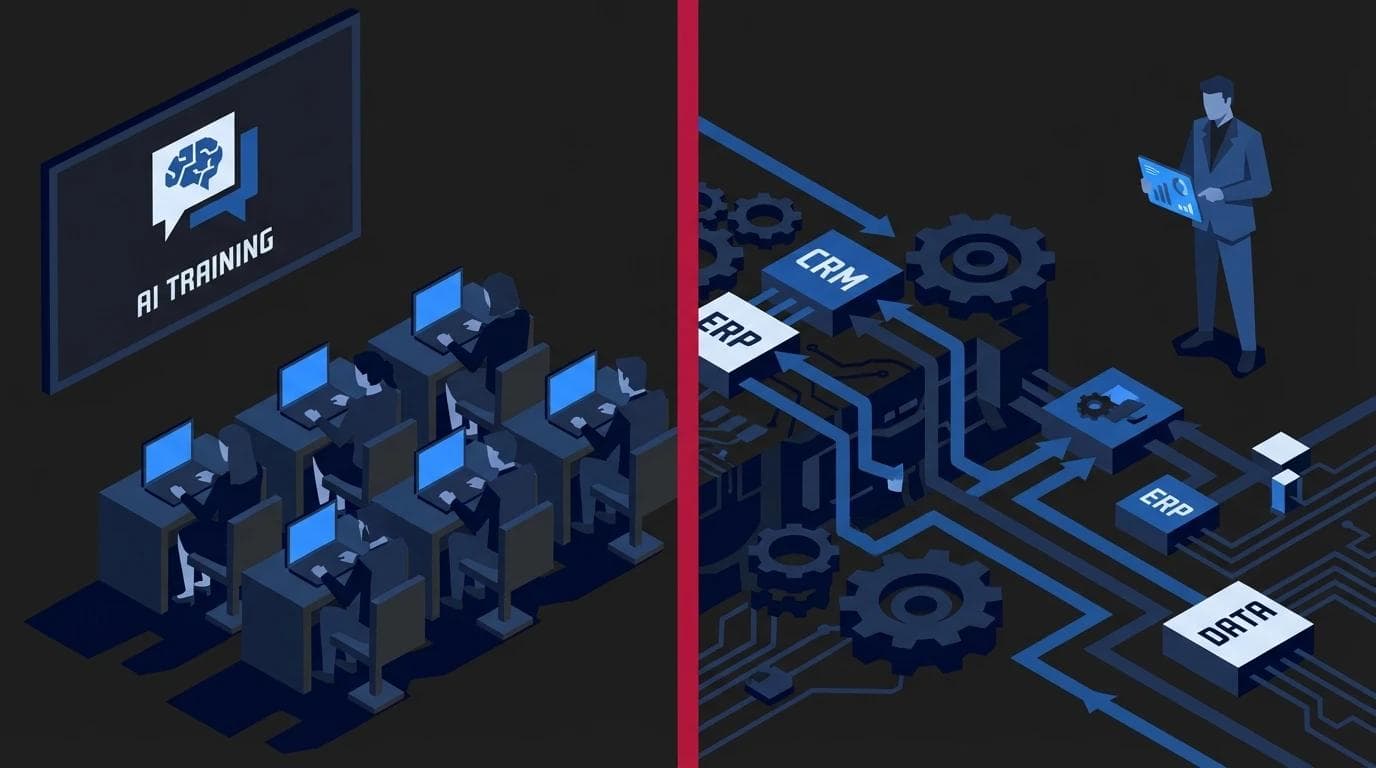
Team education and preparation - technology is only a tool in human hands, so supporting staff during the change process is crucial. Investing in AI training for business allows employees to adapt faster to new standards of working with digital documentation and fully exploit the potential of implemented systems. If you are not sure where to start auditing your resources, direct contact with an experienced technology partner will help you avoid costly mistakes at the start.
> How to Effectively Carry Out Document Digitalization in a Small Business
Effective document digitalization in a small business requires reversing typical thinking about technology - the key is to organize processes before buying licenses. The correct hierarchy of actions starts with an audit and simplification of information flow, because digitalization without prior optimization is the shortest path to chaos in a digital version. Instead of looking for a ready-made system, one should first eliminate redundant steps and touchpoints that slow down the team's work.
We always tell our clients: start with the trash can, not with software selection. Effective document workflow digitalization in a small business is 80% business organization and only 20% technology. If you move current organizational mess from a physical desk straight to a computer, the only effect will be that the same mess will work slightly faster. A proper digitalization strategy must therefore assume that IT tools are only support for healthy business processes.
To ensure the process brings real financial benefits, it is worth sticking to the following steps:
- Elimination and selection - before a document reaches the cloud, check if it is even needed. Discarding unnecessary procedures is the first step to savings.
- Workflow path design - determining who must approve a given file and at what point. Only at this stage can process automations take over repetitive tasks, such as invoice categorization.
- Choosing technology without a ceiling - in the case of specific needs, custom applications provide an advantage over off-the-shelf solutions, allowing for full code ownership and freedom of development.
- Team education - implementation does not end with software installation. Specialized AI training for business allows employees to fully utilize the potential of new tools.
Every change should be part of a broader plan, such as a digitalization financing strategy. Thanks to this approach, the company not only gets rid of paper but builds lasting technological value that becomes a company asset, not just an operational cost.
> Audit and Information Flow Mapping Before Technology Implementation
Document digitalization is not just about buying a scanner or a cloud subscription, but primarily a thorough cleanup of the company's operational processes. Auditing and mapping information flow is a key step that avoids the most common mistake in SMEs - automating chaos. Before the first line of code is written, it is necessary to precisely determine who, why, and for what purpose processes a given document.
In our practice, we often encounter situations where tradition wins over logic. We had a client from the construction industry where every invoice physically landed on the desks of four different people to obtain the necessary "initials." The audit we conducted showed that two of these people signed documents solely out of habit, as they had no real influence on the budget for years.
It is at this stage that a well-thought-out digitalization strategy works most effectively, allowing for the elimination of redundant links before they are digitally solidified. Removing these dead stages allowed us to prepare the ground for custom applications that actually improve work instead of just duplicating it in digital form.
Information flow mapping should focus on three pillars:
- Identification of hotspots - pointing out places where documents sit longest waiting for a decision.
- Verification of decision-making roles - checking if every employee involved in the process actually brings substantive value to it.
- Simplification of the critical path - designing the shortest possible route from document receipt to its final archiving.
With this approach, an optimized process moved to the digital sphere can bring huge time savings. In the case of the mentioned construction company, implemented process automations shortened invoice approval time from a full week to just a few hours.
> Choosing a Technology Model and Avoiding Costly SaaS Traps
The decision on the technological model determines the company's profitability for years. The choice between a ready-made cloud solution and building your own system is not just a technical issue, but primarily a digitalization financing strategy that directly affects the future margins of your business. In the world of document digitalization, the most common trap is the SaaS (Software as a Service) model, which promises a low entry threshold but becomes a financial burden over time.
Popular off-the-shelf document workflow systems work like a taximeter. They charge you for every added user or for a package of 1000 uploaded documents. When your company grows, a 500 PLN bill suddenly becomes 5000 PLN per month, which drastically reduces operational profitability. That is why at 01tech, we design our own solutions in the CapEx model. You pay once for engineering implementation and gain a tool you own, resistant to subscription hikes or hidden fees.
To avoid subscription traps, it is worth considering key aspects of technological ownership:
- CapEx model and code ownership - instead of endless subscription fees, you invest in a company asset. Thanks to this, you gain ownership of the tool, which is the foundation of a secure digitalization strategy.
- Custom applications without limits - by designing custom applications, we create systems tailored to your real needs, where the number of users or documents does not affect monthly maintenance costs.
- Deep process automations - your own solution allows for free process automations that connect with your current ecosystem and, if necessary, can even cover iot and hardware.
At 01tech, we focus on building long-term value. Your own code is not just savings; it is a company asset that increases its market valuation and provides independence from external suppliers. To fully exploit the potential of such tools, we also offer AI training for business, teaching teams how to independently develop and optimize implemented systems.
If you want to calculate when your investment in your own technology will pay off, we encourage direct contact. We will analyze your current subscription spending and propose a model that turns operational costs into lasting technological capital.
> Designing Digital Workflow Instead of Simple Paper Scanning
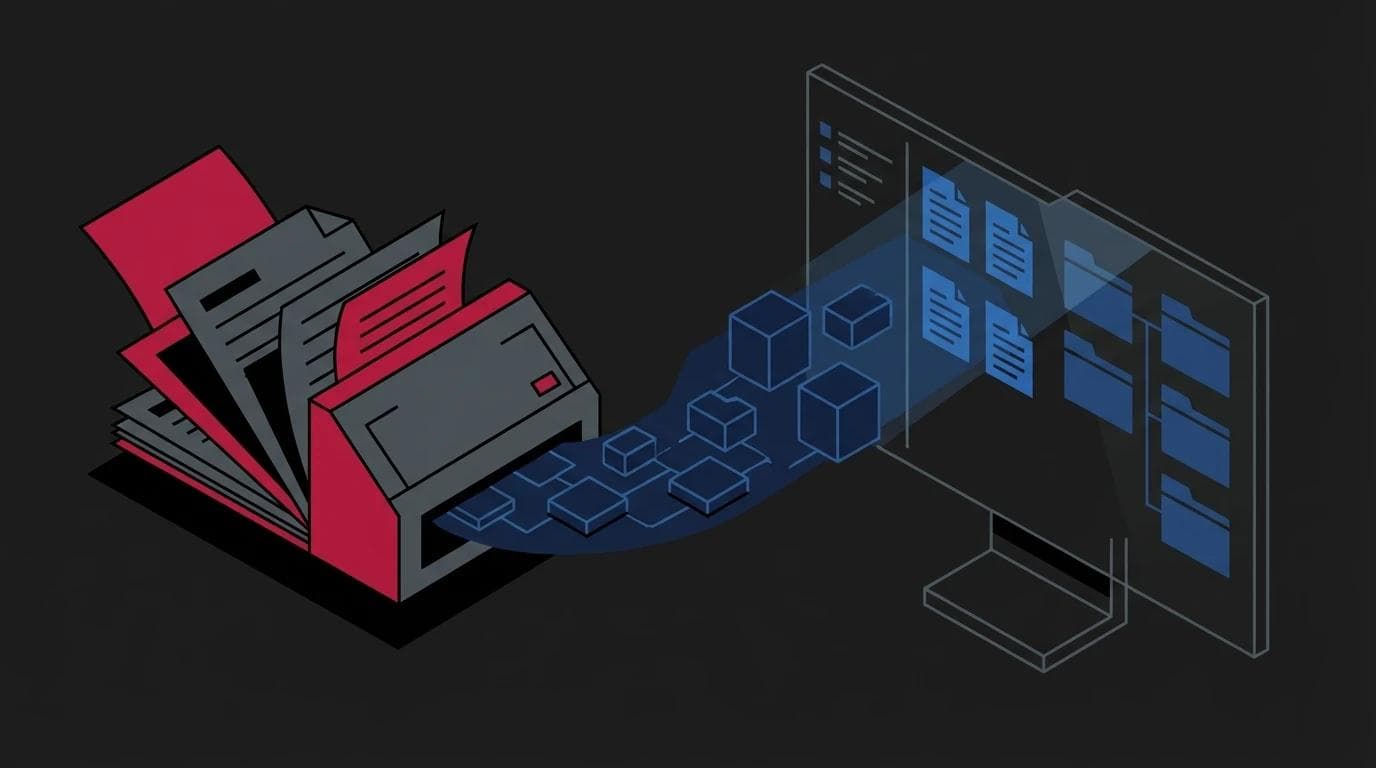
Scanning a paper contract into a PDF file is just the beginning of the road, not the goal itself. Many organizations make the mistake of treating a file server as a virtual, passive binder that in no way supports daily operations or facilitates team work. True digitalization begins where manual file management ends and intelligent information flow design starts.
The key to real savings is digital workflow - the moment when the system, after adding a file, independently reads key parameters such as payment date, amount, or service deadline. This approach makes technology work actively for the employee instead of just storing documentation. Well-planned process automations allow the system to independently send a reminder to accounting or generate a ready payment draft, which drastically shortens administrative handling time.
Implementing such an architecture is not just a matter of convenience, but an element of a broader concept, which is a digitalization strategy. Instead of relying on ready-made, closed tools that impose rigid frameworks, it is worth investing in custom applications. They allow for full control over data structure and the way it is automatically processed, eliminating technological ceilings typical for off-the-shelf solutions.
An effective information flow system should be characterized by three pillars: Automatic data extraction - total elimination of human error when transcribing invoices or contracts thanks to OCR and AI technologies. System proactivity - algorithms independently monitor deadlines and initiate subsequent steps in the process, relieving decision-makers from remembering details. Deep integration - data flows seamlessly between different departments, which is the foundation of a profitable and scalable business.
If your company is stuck at the stage of collecting digital document images, it is worth considering professional AI training for business. They help understand how modern algorithms can take over the most tedious office tasks. In more complex environments, it is also worth combining workflow with data coming directly from physical infrastructure, which advanced IoT and hardware systems enable. To effectively move from a passive archive to an active system, the best first step is direct contact with experts who will help map processes and select technology for your enterprise's real needs.
> Team Training and Digital Data Work Culture
Even the most advanced technology will fail if we ignore the human factor. We have seen it many times - a company implements a new system, and employees still print PDFs first, sign them with a pen, and scan them again. This absurd workflow usually results from the fact that no one consulted the team on how they would work more comfortably. True digital transformation starts with understanding the daily habits and fears of the people who will use this technology every day.
The key to success is not expensive and boring interface operation courses, but creating - preferably together with an experienced technology partner - a tool so intuitive that resistance to change disappears on its own within a few days. When custom applications are implemented, their functionality should stem directly from the team's work logic, not from top-down imposed schemes. Only then will employees feel that digitalization is a facilitation for them, not another bureaucratic obligation.
Building a data work culture takes time and a proper approach to education. It is worth focusing on substantive AI training for business that shows practical benefits from automation and digital information flow. An employee who understands that the system relieves them of tedious data transcription becomes an ambassador for change within the organization. A properly planned digitalization strategy always includes a stage of cultural adaptation.
Introducing new standards for working with electronic documentation is best based on three pillars:
- Collaborative process design - inviting employees to submit comments during the tool creation stage makes them feel like co-owners of the new solution.
- Elimination of entry barriers - well-designed process automations should be simpler to use than their paper counterparts, which naturally phases out old habits.
- Technological ownership - understanding how company systems work builds confidence in employees, which is discussed more broadly in the digitalization financing strategy, emphasizing the importance of owning the code.
If your goal is lasting change, not just buying software, we invite you to contact us to talk about how to combine technology with the real needs of your people. Remember that ultimately it is not servers, but people who decide whether digital documents will become fuel for company development or just a dead record on a disk.
> Frequently Asked Questions About Document Digitalization in the SME Sector
Document digitalization in the SME sector is not just about switching to scans, but primarily a change in the philosophy of managing operational processes. It is best to start with areas generating the greatest loss of time and money, such as cost invoices and supplier contracts, building a solid foundation for more advanced process automations. A properly planned transformation allows for the elimination of bottlenecks and regaining control over the information flow in the company.
Which documents should be digitized first?
The choice of starting point determines how quickly the organization will feel a real return on investment. We always advise our clients to start with those documents that are most often lost and generate the highest operational costs - usually these are cost invoices and supplier contracts. Their flow in paper form often paralyzes accounting and logistics departments, leading to payment delays or settlement problems.
However, it is worth understanding a key conceptual difference. Can scanning invoices be considered digitalization? No, that is only digitization, i.e., changing the medium from paper to digital. True digitalization begins when an automated process works around that digital file, and data is automatically read and sent to the appropriate systems. An effective digitalization strategy assumes that technology is meant to eliminate manual errors, not just replace physical binders with folders on a disk.
How to avoid digital mess after giving up paper?
Giving up paper without introducing clear file management rules quickly leads to information chaos. To avoid this, it is crucial to develop a folder structure as well as naming and tagging standards for documents. A properly cataloged digital resource must be easily searchable for every authorized employee.
Data organization rules - it is worth implementing a universal file naming scheme, e.g., [Date][DocumentType][ContractorName]. However, this is a basic solution. In more extensive structures, custom applications work best, automatically categorizing documents and allowing for their instant filtering. If a company manages a large number of physical assets, iot and hardware solutions that permanently link physical objects with their digital counterparts in the system can be helpful.
Does document digitalization require large initial financial outlays?
Many entrepreneurs fear that digital transformation is the domain of only large corporations with huge budgets. In reality, the key is process optimization, not buying the most expensive off-the-shelf licenses on the market.
Custom system vs ready-made subscription - creating a dedicated document workflow tool costs more at the start than the first month of a subscription for a ready-made SaaS platform. However, the lack of fixed monthly fees charged for every employee means that this investment usually pays off within the same year. Thanks to this approach, the company gains full technological ownership and a tool perfectly tailored to its unique needs. To better understand how to wisely plan such implementations, it is worth considering professional AI training for business or simply contacting experts who will help analyze the project's profitability for your specific case.