SUBJECT: Digitalization Strategy for CEOs: Measurable Goals

Digitalization Strategy for CEOs and Effective Setting of Measurable Transformation Goals
> Key takeaways for executive management
An effective digitalization strategy is primarily a business decision focused on generating a measurable ROI, rather than a technology project consisting of purchasing hardware or licenses. For executive management, this means moving from a cost model to an investment model, where the key is building operational value through proprietary software ownership and eliminating chaos before implementing any IT tools. A profitable transformation requires that every dollar spent on technology translates into increased margins, data security, or a unique market advantage resulting from owning your own intellectual property rights.
To facilitate the quick absorption of the most important aspects of a modern approach to IT, we have prepared a summary of key principles for business leaders:
- Digitalization as an ROI investment - digitalization strategy is not about purchasing servers or the latest laptops for the team, but a strategic business decision with a hard return on investment. The board should evaluate IT projects through the prism of how they will realistically affect operating costs or increase revenue, analyzing specific benefits of digitalization of processes before making binding decisions.
- Building company value through technology ownership - a good board invests in proprietary software (IP), which directly increases the valuation and operational value of the enterprise. Instead of becoming dependent on external provider subscriptions, it is worth focusing on custom applications, which become a permanent asset of the company and its unique market advantage, impossible for competitors to copy.
- No digitizing chaos - the last thing a CEO should do is pay to digitize organizational mess, because implementing systems into disordered structures only perpetuates inefficiency. Effective business process optimization must precede any programming work to avoid burning through the budget on features that do not solve real problems.
- Strategic approach to automation - modern management requires process automation to be implemented where repetitive activities generate the largest bottlenecks. Ignoring this stage and lacking a plan is a direct path to experiencing the negative consequences of digitalization without a plan, manifested by high maintenance costs of unnecessary systems that complicate the team's work instead of helping.
- Readiness for digital technology implementation - this process requires not only capital but also a mental shift in the organization, where technology becomes an integral part of the business model. When deciding on a specific digital technology implementation, the board must consider the long-term flexibility of the solution and how easily it can be scaled in the future.
> What is a digitalization strategy and why it must stem from business goals
A digitalization strategy is an operational plan that defines how technology will achieve specific business goals of the enterprise, such as increasing margins or reducing operating costs. From a management perspective, it is not an IT department's wish list, but a precise answer to the question of how to eliminate growth barriers using digital tools. Instead of implementing trendy solutions for the sake of having them, an effective strategy focuses on measurable profit. At 01tech, we follow an engineering approach - technology itself has no value until it realistically impacts the bottom line. CEOs often hear from advisors that their company must move to the cloud or urgently implement AI. Our answer is different - a true digitalization strategy is about finding the bottlenecks where money is leaking. Examples of such problems may include: - Leaking leads - the lack of a coherent system causes inquiries to get lost in a maze of emails instead of going to the CRM. - Stalled invoices - manual document flow delays payments and disrupts cash flow. - Reporting errors - data scattered across multiple spreadsheets makes it impossible to make quick management decisions. Understanding these challenges makes business process optimization before IT implementation the foundation of success. Only after they are organized can process automation be put to work, discreetly saving thousands of dollars per month. A good strategy prevents a situation where the company falls into technological chaos. If implementation takes place without a coherent vision, the consequences of digitalization without a plan are often costly and discourage the team from further changes. To avoid this, it is worth considering custom applications that are tailored to specific business needs rather than forcing the organization to fit into the rigid framework of off-the-shelf software. We invite you to contact us to discuss how to translate your business goals into a specific technological architecture.
> How to talk to engineers about business goals without knowing code
An effective conversation with an IT team does not require a leader to know Python or database architecture. As a CEO, you are responsible for setting growth directions, and a digitalization strategy is a tool that should support this growth, not complicate it. The boss is not there to write code or choose a specific server technology. In meetings with SME owners, we want to hear about real operational problems, not technical specifications. If your problem is that three employees spend four hours every day manually copying supplier price lists from Excel, that single sentence is the most valuable piece of information for engineers. Our role as an IT partner is to select such process automation that this tedious time drops from several hours to a fraction of a second. Expect a measurable return on investment (ROI) from the technology team, and leave the technical details to specialists who know how to implement them. Understanding that business process optimization must precede programming itself allows you to avoid creating expensive but useless tools. Before a proposal to buy a ready-made system is made, it is worth considering custom applications, which give full control over intellectual property and have no technological ceiling. In the transformation process, it is worth remembering a few key communication rules: - Describe the goal, not the function - instead of asking for a button in the panel, say that you want e-documentation to be available to sales representatives in the field in real time. - Focus on information flow - the engineer must know what the data digitalization process looks like to design a system that maintains data consistency between departments. - Demand security and ownership - every data digitalization must involve protecting your company's know-how, which is the foundation of building a market advantage. Often the first step in SMEs is simple document digitalization, which immediately frees up the team's time resources. When you decide on a digital technology implementation, think of it as an investment in company assets, not just an operating cost. A properly conducted conversation makes the benefits of digitalization visible after the first few weeks of the new system's operation. If you feel that technology is becoming a barrier instead of a support, it is worth contacting experts to discuss your business challenges without technical jargon.
> Measurable success indicators of digital transformation in SMEs
In the model of building proprietary technology, every investment must be evaluated brutally and purely mathematically. IT in a company is not an image expense, but a tool that must pay off in the Profit and Loss (P&L) statement. An effective digitalization strategy is based on hard data, not on a subjective sense of modernity.
A key parameter we look at is recovered man-hours. These are most often generated by well-thought-out process automations that free employees from repetitive, mechanical tasks. This allows the team to focus on high-margin activities, which is the foundation of profitability in the SME sector.
Another indicator is the Error Rate, i.e., the human error coefficient, which often generates hidden costs. An example could be mistakes in offers prepared by sales representatives, which can effectively eat up the entire margin on a contract. By implementing custom applications, we eliminate these risks through automatic data validation and rigid business rules.
In the area of logistics and production, the decisive indicator is Lead Time. We measure how much shorter a package stays in the warehouse without a label or how quickly an order moves to the implementation stage. Using modern IoT and hardware solutions, a company gains insight into process bottlenecks in real time.
When analyzing the main benefits of digitalization, it is worth focusing on four pillars:
- Recovered man-hours index - the amount of time that employees can devote to tasks generating real profit instead of administration.
- Redukcja Error Rate - a measurable decrease in the number of complaints and corrections resulting from incorrect data entry into systems.
- Lead time shortening - the pace of information and goods flow through the entire organizational structure, from order to shipment.
- Unit service cost decrease - the reduction of operating expenses needed to finalize a single transaction.
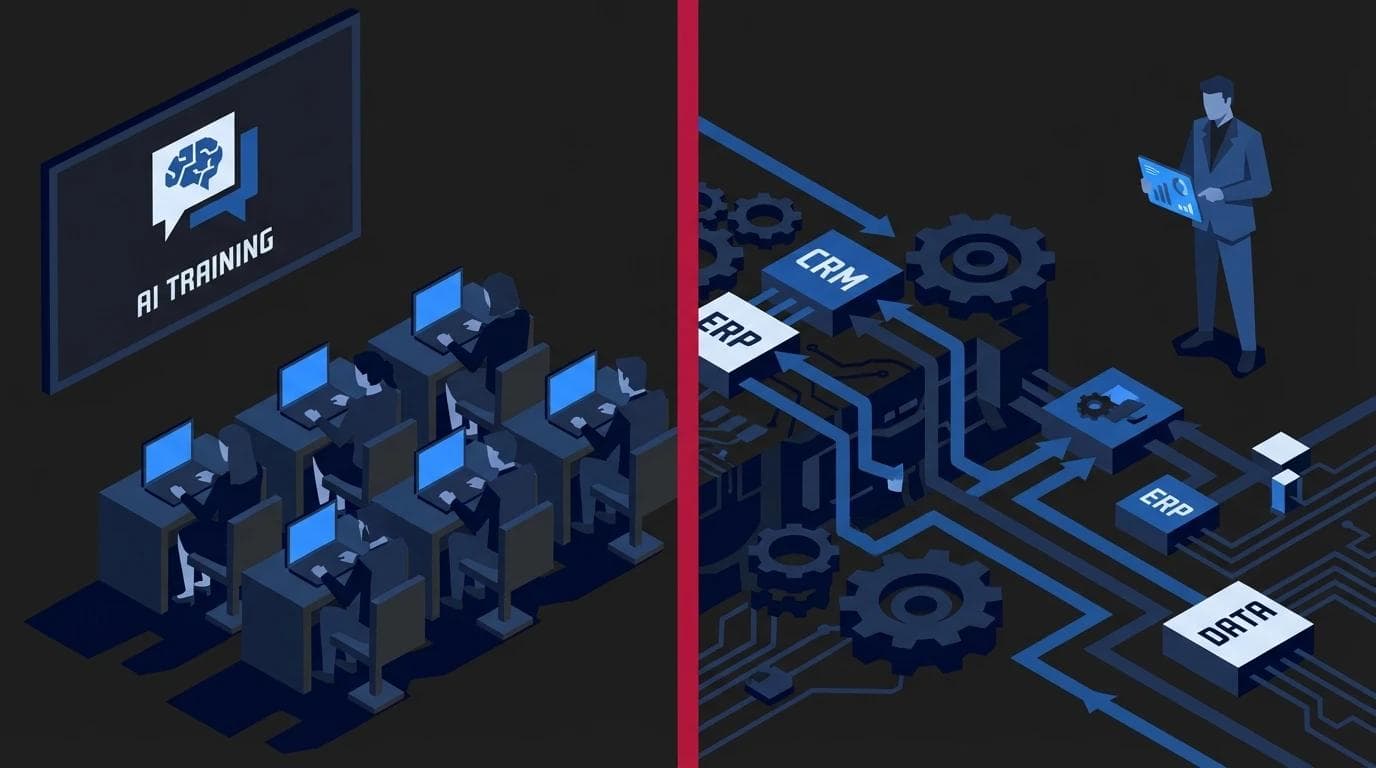
For these results to be lasting, AI training for business is also necessary, which teaches staff how to effectively use new tools. If you want to precisely calculate the potential return on investment in your company, we invite you to contact our analysts.
> Investing in technology ownership as an element of long-term strategy
Investing in proprietary technology is the foundation of stable growth, allowing you to avoid the so-called SaaS trap. Unlike using ready-made platforms, building your own IP makes the company the owner of its most valuable processes, which directly increases its market valuation.
By making the organization dependent on expensive subscriptions, you risk that your revenues will grow only proportionally to the costs of maintaining personnel. However, your own digital ecosystem allows you to effectively decouple operating costs from the scale of the business. You can handle ten times more orders using the same scripts and process automations without having to increase the administrative team in the office.
By choosing custom applications instead of off-the-shelf systems, you gain full control over the development of the tool. This allows you to avoid the technological ceiling that often appears in ready-made solutions when attempting an unusual integration. Such a digitalization strategy translates into real security and independence from the pricing policies of external providers.
This issue is inextricably linked to information protection. Appropriate data digitalization and security of the company is much easier to implement when you decide on the system architecture. Proprietary solutions, sometimes also including IoT and hardware, create a unique competitive advantage that cannot be easily copied.
Long-term success also requires preparing staff to work with modern tools. By implementing AI training for business, you teach the team how to manage intellectual property instead of just being a passive software user. If you want to discuss how to transfer your key processes to proprietary solutions, it is worth establishing contact with a team that will help design an architecture tailored to the scale of your enterprise.
Advantages of owning your own IP include:
- Scalability without headcount growth - the ability to handle more traffic with the same technical resources.
- Company value growth - proprietary code and unique algorithms constitute hard assets during a possible sale of the company.
- Full control over data - the elimination of risks of information leakage from third-party platforms.
You can read more about how to wisely plan the budget for such investments in the article discussing digitalization financing strategy and code ownership.
> Choosing implementation priorities - from automation to AI training
An effective digitalization strategy is not about implementing all available technological innovations at once, but about precisely identifying the weakest links in the value chain. The CEO of a modern organization should primarily identify so-called human middleware - employees whose sole task is to act as an interface for moving files and data between incompatible systems. This is where the greatest efficiency reserves lie.
Instead of building huge, risky architectures from scratch, it is worth starting from a stage where document digitalization in a small business becomes the starting point for deeper changes. First, we patch operational gaps with discreet scripts and simple tools that free people from repetitive tasks. Such a smooth step-by-step data digitalization process allows the organization to gain the necessary breathing room and space for more advanced investments without paralyzing current activities.
Only when basic process automations eliminate manual errors can you move on to implementing advanced technologies. However, it should be remembered that every business process optimization before IT implementation is crucial to avoid digitizing chaos, which is the most common cause of burning through budgets. In many cases, custom applications turn out to be the optimal choice, allowing for full code ownership and eliminating the technological ceiling typical of off-the-shelf solutions.
Once the foundations are stable, the next step in the hierarchy of priorities should be:
- Targeted AI models - instead of generic solutions, we implement algorithms tailored to specific business challenges that realistically support analytics or production.
- Training and competency development - investing in AI training for business makes sense only when the team learns on real company problems, not on theoretical examples.
- Hardware integration - in manufacturing companies, it is worth considering IoT and hardware solutions that allow for collecting data directly from production lines.
- Modern e-documentation - implementing systems such as e-documentation closes the process of digital flow of invoices, contracts, and HR documentation.
When choosing a development path, the CEO must be aware of the consequences of digitalization without a plan, which often lead to a loss of data consistency and increased costs of maintaining technological debt. At the same time, measurable benefits of digitalization should be visible at every stage of implementation, which facilitates change management within the organization. A comprehensive approach to this process, including both digital technology implementation and security, means that data digitalization and company security stop being a challenge and become the foundation of stable growth. If you need support in setting priorities for your company, contact us to plan a profitable transformation together.
> Frequently asked questions about digitalization strategy
Planning a digital transformation raises many questions for management, especially in the SME sector, where every mistake can be costly. An effective digitalization strategy requires not only choosing the right tools, but above which, changing the way of thinking about technology as a profit-generating asset rather than just an operating cost. The key to success is avoiding chaos and focusing on areas that bring the fastest return on investment.
How to start creating a digitalization strategy in a small business?
Every technological change must start with an audit of the current state of affairs. First, identify the departments that have the greatest impact on the company's cash flow, because that is where optimization will bring the most noticeable financial effects. From a practitioner's perspective, it is usually worth focusing on automating invoice flow and optimizing the sales funnel, which allows for faster capital recovery.
However, before you implement specific tools, business process optimization is essential to avoid digitizing a mess. Only after organizing the operational patterns can you introduce process automations that will realistically relieve the team and eliminate repetitive manual errors. A good starting step is also document digitalization, which constitutes a foundation for further development of data analytics.
What mistakes do CEOs most often make in communication with the IT department?
The biggest mistake of decision-makers is focusing on specific system functions instead of measurable business results. When a CEO communicates with the IT department or an external software house, they often ask for a specific button in the application instead of describing the problem that a given module is supposed to solve. This approach leads to situations where custom applications are created overloaded with useless options, which unnecessarily increases project costs.
Another critical mistake is the lack of precise goals, which generates negative consequences of digitalization, such as exceeding the budget or low adoption of the tool by employees. The strategy should clearly state whether the goal is to shorten order fulfillment time by 20% or perhaps reduce archiving costs. If you plan to develop your own software, a digitalization financing strategy and code ownership is also key to avoid dependence on a single technology provider.
How long does it take to develop and implement the first stages of the strategy?
In the SME sector, the strategy development process usually takes 4 to 8 weeks and includes a process audit and selection of priorities. The actual digital technology implementation should be divided into stages, where the first one ends with the delivery of an MVP (Minimum Viable Product) within 3-5 months. This allows the company to quickly test assumptions and collect feedback from end users without committing huge resources at the start.
A realistic schedule must also include time for the team to learn. Sometimes AI training for business is necessary so that employees can fully utilize the potential of new tools. A full transformation, including the data digitalization process and integration of ERP systems with IoT and hardware solutions, is a continuous process that evolves along with the growth of the company's scale and market changes.