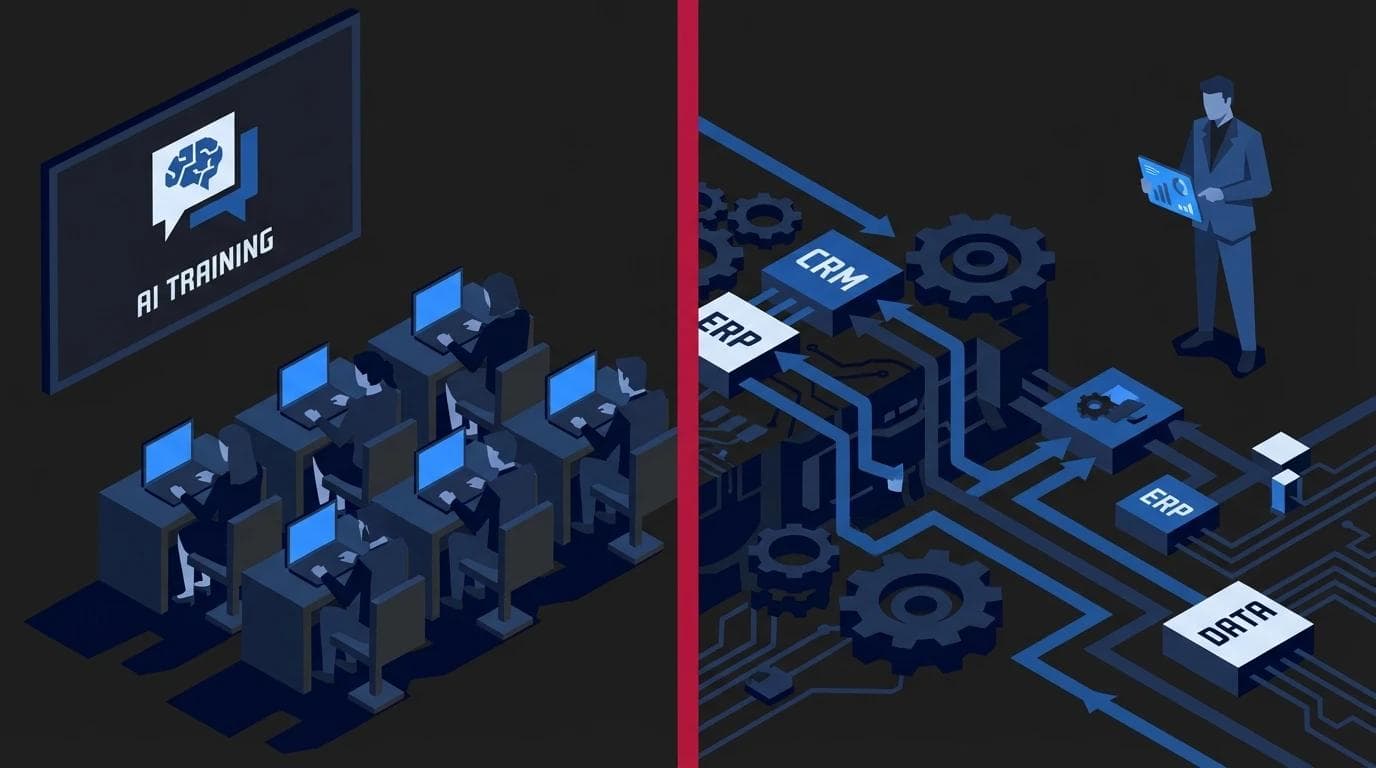
SUBJECT: Practical AI Training for Companies - Real Productivity

AI Training for Companies - How to Escape the Hype and Truly Boost Team Efficiency
> What Substantive AI Training for Companies Is and How to Tell It Apart from Empty Promises
Substantive AI training for companies is a strategic competency change process that translates the potential of artificial intelligence into a real return on investment (ROI). Effective education in this area is not about learning to write creative prompts, but about precisely identifying bottlenecks in the organization and implementing secure technical solutions. True training allows managers to understand where technology can free up thousands of man-hours per year, while maintaining full compliance with GDPR and AI Act regulations. You can recognize an effective workshop by the fact that instead of fascination with novelties, engineers analyze your real data to pinpoint processes ready for immediate optimization.
Currently, the market is flooded with AI trainers who focus solely on how to nicely phrase a sentence in ChatGPT. From an engineering perspective, this is a waste of time and budget. Reliable szkolenia AI dla biznesu should teach how to free human resources from routine, not just how to operate a chat interface. An expert approach means that after leaving the room, the employee can independently map their most boring, repetitive process and knows which tools to use to eliminate it.
To distinguish substantive knowledge from marketing noise, it is worth paying attention to several key foundations:
- Process-oriented approach instead of a hobbyist one - a professional does not start by showing how to generate images, but with an operational audit. The goal is to find space for automatyzacje procesow that will perform the boring work for the team.
- Engineering knowledge of security - substantive training teaches how to configure closed environments and private model instances so that your know-how does not leak into public training databases.
- Recognizing technological barriers - an engineer-trainer will point out the moment when ready-made AI blocks are no longer enough and aplikacje dedykowane built for specific business logic become necessary.
- Data integration in industry - in the manufacturing sector, education must go beyond text and include data from machines, which is enabled by iot i hardware combined with predictive algorithms.
- Impact on sales channels - for the SME sector, it is crucial how AI improves tworzenie sklepow internetowych through intelligent product categorization or personalization of the customer journey.
Remember that substantive training ends with an implementation list and a clear plan to reclaim employee time, not just a certificate on the wall. At 01tech, we believe that small companies also deserve Enterprise-class standards, which is why we train on solutions that are secure, scalable, and, above all, yours to own.
> Why Your Company Needs a Strategy, Not Just a ChatGPT Subscription
Buying employees access to ChatGPT Plus and sending an email saying "from today we use AI" is the easiest way to technological chaos. Although these tools are powerful, without proper supervision, they generate the Shadow AI phenomenon - employees, wanting to make their work easier, start uploading confidential customer data, company strategy, or sensitive invoices to public models over which the management has no control. Strategic implementation is not just about chat access, but above all, conscious management of information and security.
True transformation begins where playing with prompts ends and the strategia cyfryzacji CEO appears, defining measurable goals and work standards. Instead of relying on public platforms, modern organizations opt for closed environments based on models via API, which guarantees that your data will not be used to train publicly available algorithms. This is exactly what reliable szkolenia AI dla biznesu teach - how to build a security architecture and set clear rules for information processing.
The key to success is understanding that artificial intelligence is the fuel, but your systems are the engine. Therefore, instead of multiplying SaaS subscriptions, it is worth considering tailor-made solutions:
- Process automation - this is the use of technology to perform boring work in the background. Thanks to automatyzacje procesow, you save hundreds of hours that the team used to waste on copying data.
- Dedicated applications - when ready-made tools become a "golden cage", your own aplikacje dedykowane give you full code ownership and unlimited scalability.
- Integration with the physical world - AI can analyze data from sensors in production if you implement the right iot i hardware systems.
- Intelligent sales - modern sklepy internetowe use algorithms to personalize the offer in real-time, which directly translates into a higher ROI.
Strategy allows you to avoid "burning" the budget on tools that no one can extract real business value from. This is the difference between being a user of technology and being its conscious owner.
> Four Pillars of Effective AI Training - From Mindset to Automation
Implementing artificial intelligence in an organization is not about purchasing a license, but an operational change. Effective szkolenia ai dla firm are based on four foundations that turn theoretical enthusiasm into measurable ROI. We are not looking for "magic", but for bottlenecks that AI can clear right away.
Readiness Audit and Identification of Processes for Automation
The foundation is understanding that the team does not need another lecture on the history of neural networks, but tools to solve specific problems. We start the audit with a question: what do your people actually struggle with every day? The fastest gains come from automating repetitive tasks with high data volumes, where "human middleware" (manual data rewriting) generates errors and costs.
To select processes for AI implementation, we use a simple matrix:
- Frequency of occurrence - we choose tasks performed daily or weekly.
- Digital nature of data - information must be available in text, database, or Excel spreadsheet formats.
- Clear decision rules - AI performs best where the process has a defined pattern, even if it requires natural language interpretation.
Identifying such areas allows for targeted automatyzacje procesow that pay off in the first months after training. It often turns out that instead of teaching employees to write poems in ChatGPT, it is better to implement a script that automatically classifies sales inquiries entering the system.
The next pillar is AI data security and work hygiene - leadership education must cover GDPR fundamentals and privacy configuration in enterprise tools. We teach the team how to disable model training on their data and what must never be pasted into public chats.
The third step is practical workshops on real resources - we abandon made-up examples. If we are training the logistics department, we work on their actual Excel sheets with shipping data. If we are optimizing tworzenie sklepow internetowych, we analyze real customer feedback and product descriptions. This builds real competencies because the employee sees that the tool shortens their work from three hours to a dozen minutes.
The last, most advanced pillar is integration and going beyond the chat interface - the true power lies in orchestration. We show how to use platforms like n8n to connect an AI model with email and CRM. In such a scenario, AI becomes an autonomous assistant that receives emails, classifies them, and independently pushes data into the database.
When standard solutions are no longer enough, we design aplikacje dedykowane that integrate AI directly into the production process. We often combine the digital and physical worlds, using iot i hardware for intelligent machine monitoring and predictive maintenance.
> How to Measure the Real Return on Investment in Team Technology Education
Investing in knowledge is not a cost, but pure mathematics. The real return on investment (ROI) is easiest to measure through a hard analysis of the time spent on repetitive tasks. Effective szkolenia AI dla biznesu should translate into specific operational KPIs, such as the number of man-hours recovered or the elimination of bottlenecks, not just a course completion diploma.
Training must pay off - this is the engineering approach we use at 01tech. After our workshops, we ask companies to track one key metric: how many hours per week a given department has stopped spending on boring "data rewriting". We have specific proof: for one of our e-commerce clients, training the team in automatic product categorization via API freed up as much as 20 hours of work per week on a single full-time position. This shows that properly implemented korzysci cyfryzacji procesow biznesowych i mierzalne wskazniki ROI are the foundation of profitability.
Key KPIs worth monitoring after implementing AI education:
- Number of man-hours recovered - the sum of time employees recovered thanks to the automation of routine inquiries or reports. This is time they can now spend on strategic thinking.
- Reduction in onboarding time - using AI to create intelligent knowledge bases allows new people to enter company procedures 30-50% faster.
- Elimination of human errors - a decrease in the number of data mistakes resulting from fatigue. This is particularly important when a company implements complex aplikacje dedykowane requiring precise information entry.
- Scaling without increasing employment - the ability to handle a larger volume of traffic or orders with the same team size. This is crucial when planning tworzenie sklepow internetowych with high transaction intensity.
Often, the training itself becomes a trigger for deeper changes. Seeing the potential of the tools, teams themselves start designing automatyzacje procesow that permanently remove routine from their daily schedule. In a world where efficiency counts, technology education is the simplest way to build a market advantage.
> Security and Ethics - How to Train Employees Not to Expose the Company to Data Leaks
Safe use of AI in a business environment starts with understanding one principle: free tools learn from your data. Pasting the content of a confidential contract or financial data into a publicly available chat window in a browser is a direct breach of trade secrets. To avoid leaks, companies must implement Enterprise-class standards and train the team in secure prompting and information management.
The most important slide in each of our workshops makes employees aware that in free models, their queries become fuel for future versions of algorithms. However, the solution is not technological prohibition, but professional szkolenia AI dla biznesu that teach the use of dedicated environments. By choosing paid tools or access via API, providers legally guarantee a Zero Data Retention policy - this means that data is not stored or used to train external models. Such a security architecture is the foundation when aplikacje dedykowane integrated with internal company systems are created.
Key principles of safe work with AI:
- Technical data anonymization - we teach employees how to modify prompts so that the model operates on the logic of the problem, not on specific names or project titles.
- Choosing closed models - instead of public chats, we implement solutions where the company has full control over the flow of information.
- Compliance with GDPR and AI Act - education must cover the legal aspects of generative intelligence, especially in areas such as digitalizacja danych i bezpieczenstwo wlasnosci intelektualnej.
Proper team training allows for the safe implementation of advanced solutions like automatyzacje procesow. Then, digital robots can operate on company data without the risk of making it public. Even in sectors like e-commerce, where tworzenie sklepow internetowych is increasingly based on intelligent analytics, ethics and customer privacy protection become the most important element of competitive advantage. For projects on the border of the physical world, like iot i hardware, these standards are critical to prevent unauthorized persons from taking control of the infrastructure.
> FAQ - Frequently Asked Questions About AI Training for Companies
The decision to invest in AI training for companies is not just a matter of budget, but above all, a change in the team's mentality. Most managers fear employee resistance or a lack of technical skills, but in practice, these barriers disappear faster than one might expect. The key is to show real added value in daily duties.
Is AI training intended only for technical employees?
Absolutely not - artificial intelligence today is primarily a tool supporting HR departments, administration, sales, and marketing. Participants do not need to know how to program or understand complex algorithms to benefit from the new technology. Our experience shows that team resistance disappears in the first 43 minutes of the training, when we present a live example to an employee of how a simple script takes over the most disliked and repetitive part of their work. It is these small victories that build trust in the technology and make szkolenia AI dla biznesu a catalyst for real changes in the organization.
How much time is needed for the team to start truly saving time thanks to AI?
The first effects are visible immediately after the workshop - employees start replying to emails faster, creating meeting summaries, or generating simple reports. However, full structural optimization occurs after a few weeks, when the habit of using AI assistants becomes a permanent part of the company routine. In many cases, after conducting the training, it turns out that instead of adding more tools to employees, automatyzacje procesow work better, operating quietly in the background and freeing the team from "data rewriting" between systems. Such a model allows for reclaiming up to a dozen hours of work per week across a single department.
Which tools are discussed during professional AI training for business?
We always adapt the training program to the specifics of the industry, but the standard set includes enterprise-class tools such as ChatGPT Team, Claude from Anthropic, and Perplexity for advanced research. However, it is worth remembering that training makes sense even if your company does not yet have paid subscriptions for every employee. A reliable audit and training often show that you do not need expensive subscriptions for everyone at all, and one well-designed integration working on the company server is enough. In situations where ready-made cloud solutions are too limited or do not meet security standards, we build aplikacje dedykowane that allow the company to maintain full code ownership and data security.